forget god and get wokr
3 stelle
What the title says. 3 stars because book was mid but the message interesting
lingua English
Pubblicato il 01 Agosto 2015
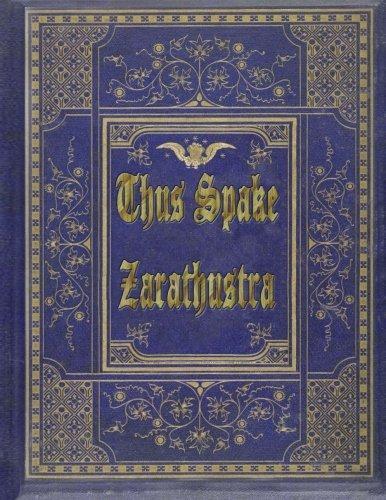
Thus Spoke Zarathustra: A Book for All and None (German: Also sprach Zarathustra: Ein Buch für Alle und Keinen, also translated as Thus Spake Zarathustra) is a work of philosophical fiction written by German philosopher Friedrich Nietzsche between 1883 and 1885. The protagonist is nominally the historical Zarathustra, but, besides a few sentences, Nietzsche is not particularly concerned with any resemblance. Much of the book purports to be what Zarathustra said, and it repeats the refrain, "Thus spoke Zarathustra". The style has facilitated variegated and often incompatible ideas about what Zarathustra says. "Zarathustra speaks about stars, animals, trees, tarantulas, dreams, and so forth". Though there is no consensus with what Zarathustra means when he speaks, there is some consensus with what he speaks about. Zarathustra deals with ideas about the Übermensch, the death of God, the will to power, and eternal recurrence. Zarathustra himself first appeared in Nietzsche's earlier book …
Thus Spoke Zarathustra: A Book for All and None (German: Also sprach Zarathustra: Ein Buch für Alle und Keinen, also translated as Thus Spake Zarathustra) is a work of philosophical fiction written by German philosopher Friedrich Nietzsche between 1883 and 1885. The protagonist is nominally the historical Zarathustra, but, besides a few sentences, Nietzsche is not particularly concerned with any resemblance. Much of the book purports to be what Zarathustra said, and it repeats the refrain, "Thus spoke Zarathustra". The style has facilitated variegated and often incompatible ideas about what Zarathustra says. "Zarathustra speaks about stars, animals, trees, tarantulas, dreams, and so forth". Though there is no consensus with what Zarathustra means when he speaks, there is some consensus with what he speaks about. Zarathustra deals with ideas about the Übermensch, the death of God, the will to power, and eternal recurrence. Zarathustra himself first appeared in Nietzsche's earlier book The Gay Science. Nietzsche himself has suggested that his Zarathustra is a tragedy and a parody. It was his favourite of his own books. He was aware, however, that readers might not understand it. Possibly this is why he subtitled it A Book for All and None. Its themes and general merit are continually disputed. It has nonetheless been hugely influential in various facets of culture.
What the title says. 3 stars because book was mid but the message interesting
So there's a tendency in Nietzsche's fans that whenever you criticize Nietzsche they think that's because you don't understand him. In this aspect Nietzsche is very similar to Wagner: if you criticize Wagner it must be that you don't understand the passionate solemnity of Wagner.
This is a great work but equally a profoundly flawed work. In fact I never liked it. I liked Nietzsche's other writings, in spite of their self-contradictions and outright stupidities, I liked, but this book is just much too theatrical. It's a work for the moderns who no longer understand what "solemnity" precisely means. So they'll be immersing themselves in Wagner's, Mahler's, and Bruckner's nearly hysterical sound masses and exclaim "solemn" and "magnificent" without realizing that this sensual chaos has nothing that solemn or "transcendental" per se. I used the word "transcendental", then Nietzsche's fans will be like, no I don't want transcendence I want …
So there's a tendency in Nietzsche's fans that whenever you criticize Nietzsche they think that's because you don't understand him. In this aspect Nietzsche is very similar to Wagner: if you criticize Wagner it must be that you don't understand the passionate solemnity of Wagner.
This is a great work but equally a profoundly flawed work. In fact I never liked it. I liked Nietzsche's other writings, in spite of their self-contradictions and outright stupidities, I liked, but this book is just much too theatrical. It's a work for the moderns who no longer understand what "solemnity" precisely means. So they'll be immersing themselves in Wagner's, Mahler's, and Bruckner's nearly hysterical sound masses and exclaim "solemn" and "magnificent" without realizing that this sensual chaos has nothing that solemn or "transcendental" per se. I used the word "transcendental", then Nietzsche's fans will be like, no I don't want transcendence I want immanence and I'm faithful to the Earth or whatever. So there's a universal lie that acts as an rhectorical device to segregate Nietzsche's fans from other people who they think are inferior.
Whether they're superior I don't know, it seems plain to me that they're not trying to understand others since this very act of trying to understand leads them to believe that they may not be that unique and that passionate - there's a hidden insecurity in their passion. Anyway, in this childish, hysterical display, I can only see something lamentable rather than something admirable.
Of course they don't want to be admired I know perfectly well. Just see how much resentment and defence they have regarding their uniqueness and passion.
Futile struggle that accomplishes the very feeling of struggle and Amor Fati by means of acting it out. Seeking its own destruction as if it is meaningful somehow. Give it up seriously. This really is a badly written work. It's good for some people, but whomever has read and actually understands this work can only pity and lament Nietzsche's downfall.
Buch 1 und 4 sind lesbar – Buch 2 und 3 sind hingegen wirklich zäh.