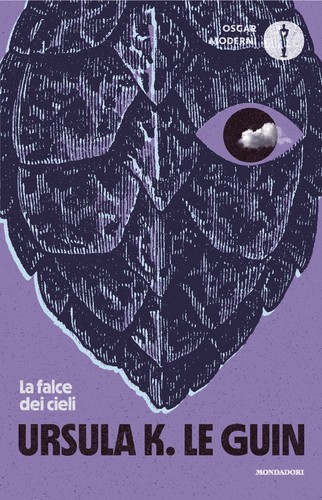
A Portland, Oregon, nell’anno 2002 piove sempre e la popolazione soffre di malnutrizione. In Medio Oriente infuria la guerra e il cambiamento climatico ha peggiorato ovunque la qualità della vita. Insomma, l’umanità non ha certo realizzato i propri sogni di pace e benessere. Ma esiste un modo per farlo? E se fosse possibile, sarebbe una benedizione… o una maledizione? È quello che si chiede George Orr, che vede diventare realtà tutto ciò che sogna. Scoperto questo “dono”, il dottor Haber, lo psichiatra che lo ha in cura, tenta di costringere l’uomo a sognare ciò che lui desidera, pensando così di liberare la Terra dai mali di sempre: sovrappopolazione, malattie, conflitti, razzismo… Insomma, di costruire un mondo perfetto. Ma a quale prezzo? Omaggio all’opera di Philip K. Dick, premiato con il Locus nel 1972, La falce dei cieli traccia una visione sorprendentemente profetica del nostro presente e trasferisce in una trama …
A Portland, Oregon, nell’anno 2002 piove sempre e la popolazione soffre di malnutrizione. In Medio Oriente infuria la guerra e il cambiamento climatico ha peggiorato ovunque la qualità della vita. Insomma, l’umanità non ha certo realizzato i propri sogni di pace e benessere. Ma esiste un modo per farlo? E se fosse possibile, sarebbe una benedizione… o una maledizione? È quello che si chiede George Orr, che vede diventare realtà tutto ciò che sogna. Scoperto questo “dono”, il dottor Haber, lo psichiatra che lo ha in cura, tenta di costringere l’uomo a sognare ciò che lui desidera, pensando così di liberare la Terra dai mali di sempre: sovrappopolazione, malattie, conflitti, razzismo… Insomma, di costruire un mondo perfetto. Ma a quale prezzo? Omaggio all’opera di Philip K. Dick, premiato con il Locus nel 1972, La falce dei cieli traccia una visione sorprendentemente profetica del nostro presente e trasferisce in una trama appassionante una profonda riflessione sui temi della realtà e dell’illusione, della possibilità per l’uomo di forgiare il proprio destino, oltre a una discussione su filosofie come positivismo, taoismo, comportamentismo e utilitarismo: «una sintesi rara e potente» ha scritto Theodore Sturgeon «di poesia e scienza, ragione e sentimento».
Mi mancava la sua scrittura, che qui è un po' meno poetica ma più esplicita nelle riflessioni profonde.
La storia è molto interessante, e come sempre abbastanza sfumata nei contorni. Bellissima.
Full spoiler free review here : system-failure.trbn.xyz/lathe-of-heaven-wip/
[...]
“Reality is an odd choice of word, when all that shapes it is a dream”, thinks the jellyfish.
We meet George Orr in the middle of an overdose. Whilst society deems him an addict, his issue is one much greater than that : he is a Dreamer.
His bed is a boat with no helm to speak of, and as he catches odd things shift in the world behind his eyes, so too does reality shape itself anew. The change terrifies him.
Should Orr attempt to swim ? Should Orr dream with intent, for the betterment of humankind, to become the Lathe of a heaven of his own making ? Or should Orr rid himself of this terrible and frightening power ? “Worse…” he thinks. “if my dreams have such potency… what will come with my nightmares ?”
A development of medical and societal ethics through the lens of a sci fi thriller
5 stelle
A slow-burn psychological thriller that ramps up to a fever pitch while hitting quite a few strong notes along the way.
The Lathe of Heaven is uniquely gripping because its themes seem to morph so fluidly throughout the novel, giving just enough breath to each to offer social commentary while still leaving plenty of air for the reader to ponder the implications. Just to name a few, the book hits on self medication, spiraling into incarceration, medical/psychological research and its ethical implications, weighing ethical responsibilities to individuals against humanity at large, our duty to monitor our unconscious biases and an amnesic fading grasp on reality. Explored in a surrealist fictional present, these topics are provided with enough distance from our real-world understanding to mull them over with fresh eyes.
Of these, I was particularly interested in the ethics of research science as these considerations still ripple through the field of …
A slow-burn psychological thriller that ramps up to a fever pitch while hitting quite a few strong notes along the way.
The Lathe of Heaven is uniquely gripping because its themes seem to morph so fluidly throughout the novel, giving just enough breath to each to offer social commentary while still leaving plenty of air for the reader to ponder the implications. Just to name a few, the book hits on self medication, spiraling into incarceration, medical/psychological research and its ethical implications, weighing ethical responsibilities to individuals against humanity at large, our duty to monitor our unconscious biases and an amnesic fading grasp on reality. Explored in a surrealist fictional present, these topics are provided with enough distance from our real-world understanding to mull them over with fresh eyes.
Of these, I was particularly interested in the ethics of research science as these considerations still ripple through the field of medical research today. The book offers a caricature of a fantastical medical research scenario, but its underpinning themes are still critical factors of any medical research. How patient consent is communicated, how experiments are approved, how the disadvantaged (in this case the addicted and incarcerated) may be exploited for medical gain, the professional impact of discovery, the profit motive of research and the calculus of weighing advancing knowledge that can benefit all of humanity against the sacrifices of individuals. These problems surface in our daily lives in an attenuated capacity and the book offers a hyperbolic chamber of decision making to allow us to weigh their impact.
Beyond the themes themselves, the mechanics of the story unfold in a very
tangible way. The only other work of Le Guin's that I've read so far is The Left
Hand of Darkness, and I found the two novels to be quite the stark contrast.
Where it felt like understanding Left Hand of Darkness' world was preconditioned on an encyclopedic memory of the world's setting, The Lathe of Heaven trimmed a lot of the sci-fi fat down to only what was necessary to drive an analysis of its themes. I appreciated how direct this was, letting me devote more of my reading energy toward reflecting on the book instead of constantly retreating into the recesses of world lore to keep up. What's more, for as much as the Lathe of Heaven sticks close to many science fiction tropes, they're approached from such a unique angle that no part of the book felt like it's been overdone, even half a century after it was written.
The Lathe of Heaven was a refreshingly concise analysis of a litany of social themes, packing quite a few narrative beats into such a concise form factor. I would consider it a must read for any fans of socially critical science fiction.
It's funny how of all the books I've read by Le Guin, the one that's set on a baseline plausible Earth-in-my-lifetime would turn out to be the weirdest. Also funny how in what starts as a pretty reasonable extrapolation from 1971 to ~2000 has one repeated glaring error: multiple references to the perfect cone of Mount St. Helen's.
Against that background, we get a story of a man running away from his dreams because they give him a power he doesn't understand and can't control. And another man who wants to channel that power, setting up a modern Daoist fable about the hubris of trying to control too much.