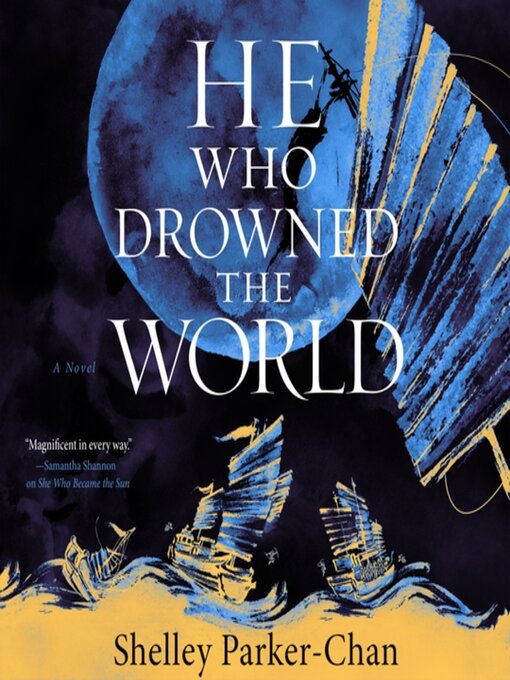
The sequel and series conclusion to She Who Became the Sun, the accomplished, poetic debut of war and destiny, sweeping across an epic alternate China. Mulan meets The Song of Achilles.
How much would you give to win the world?
Zhu Yuanzhang, the Radiant King, is riding high after her victory that tore southern China from its Mongol masters. Now she burns with a new desire: to seize the throne and crown herself emperor.
But Zhu isn’t the only one with imperial ambitions. Her neighbor in the south, the courtesan Madam Zhang, wants the throne for her husband - and she’s strong enough to wipe Zhu off the map. To stay in the game, Zhu will have to gamble everything on a risky alliance with an old enemy: the talented but unstable eunuch general Ouyang, who has already sacrificed everything for a chance at revenge on his father’s killer, the …
The sequel and series conclusion to She Who Became the Sun, the accomplished, poetic debut of war and destiny, sweeping across an epic alternate China. Mulan meets The Song of Achilles.
How much would you give to win the world?
Zhu Yuanzhang, the Radiant King, is riding high after her victory that tore southern China from its Mongol masters. Now she burns with a new desire: to seize the throne and crown herself emperor.
But Zhu isn’t the only one with imperial ambitions. Her neighbor in the south, the courtesan Madam Zhang, wants the throne for her husband - and she’s strong enough to wipe Zhu off the map. To stay in the game, Zhu will have to gamble everything on a risky alliance with an old enemy: the talented but unstable eunuch general Ouyang, who has already sacrificed everything for a chance at revenge on his father’s killer, the Great Khan.
Unbeknownst to the southerners, a new contender is even closer to the throne. The scorned scholar Wang Baoxiang has maneuvered his way into the capital, and his lethal court games threaten to bring the empire to its knees. For Baoxiang also desires revenge: to become the most degenerate Great Khan in history - and in so doing, make a mockery of every value his Mongol warrior family loved more than him.
All the contenders are determined to do whatever it takes to win. But when desire is the size of the world, the price could be too much for even the most ruthless heart to bear…
Review of 'He Who Drowned the World' on 'Storygraph'
5 stelle
It’s certainly a worthy sequel to this blend of real history and transmasc Mulan and the fraught relationship between Zhu and Ouyang takes centre stage for me. Zhu as always brings intelligence and brash confidence to every confrontation while in the background the court politics of the Great Khan begin to overtake events.
Couldn't hold my interest like its predecessor did
3 stelle
Avviso sul contenuto
Spoilers for all over both books
When I finished She Who Became The Sun, I was disappointed to have to wait for this sequel, I had loved that volume so much. But this one really didn't draw me in in the same way.
I'll start with parts I did enjoy. Parker-Chan is a great writer, both as a conjurer of scenes, and in the way they draw characters richly by switching between interior perspectives and the perceptions of others. The arc of Zhu and Ouyang haltingly moving towards understanding each other is compelling until it's cut short, and the "Zhu's capers" scenes are just as much fun as in the first volume.
But I found the shifting motivations of the characters took a lot of interest out of this oen. Wang and Ouyang felt flattened by their hyperfixation on revenge at all costs. Madame Zhang's fixation with the self-imprisoning role of Empress when she had so much real power as Queen makes no sense. Zhu's shift from desperate, audacious attempts to survive to grasping at "greatness" apparently for its own sake had the odd effect of making the stakes seem smaller even as the story gets bigger, which makes the violence feel gratuitous in turn, in a way that it never did in the first volume no matter how grim things got. And Ma and Xu both seemed shrunk by their portrayal as basically martyrs for the revolution.
I spent much of the book wondering why Zhu and Zhang couldn't just come to some detente and enjoy their successes, and why anyone other than Xu Da and maybe Ma Yinzi followed Zhu with such loyalty. Towards the end Ma has some lines which seem to explain it in a sort of social justice way, but coming so late in the book they felt tacked on.
I'm still looking forward to the next thing Parker-Chan writes, but found this one kind of a let-down.