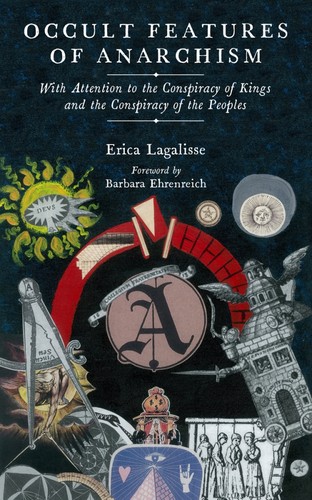
In the nineteenth century anarchists were accused of conspiracy by governments afraid of revolution, but in the current century various “conspiracy theories” suggest that anarchists are controlled by government itself. The Illuminati were a network of intellectuals who argued for self-government and against private property, yet the public is now often told that they were (and are) the very group that controls governments and defends private property around the world. Intervening in such misinformation, Lagalisse works with primary and secondary sources in multiple languages to set straight the history of the Left and illustrate the actual relationship between revolutionism, pantheistic occult philosophy, and the clandestine fraternity.
Exploring hidden correspondences between anarchism, Renaissance magic, and New Age movements, Lagalisse also advances critical scholarship regarding leftist attachments to secular politics. Inspired by anthropological fieldwork within today’s anarchist movements, her essay challenges anarchist atheism insofar as it poses practical challenges for coalition politics …
In the nineteenth century anarchists were accused of conspiracy by governments afraid of revolution, but in the current century various “conspiracy theories” suggest that anarchists are controlled by government itself. The Illuminati were a network of intellectuals who argued for self-government and against private property, yet the public is now often told that they were (and are) the very group that controls governments and defends private property around the world. Intervening in such misinformation, Lagalisse works with primary and secondary sources in multiple languages to set straight the history of the Left and illustrate the actual relationship between revolutionism, pantheistic occult philosophy, and the clandestine fraternity.
Exploring hidden correspondences between anarchism, Renaissance magic, and New Age movements, Lagalisse also advances critical scholarship regarding leftist attachments to secular politics. Inspired by anthropological fieldwork within today’s anarchist movements, her essay challenges anarchist atheism insofar as it poses practical challenges for coalition politics in today’s world.
Studying anarchism as a historical object, Occult Features of Anarchism also shows how the development of leftist theory and practice within clandestine masculine public spheres continues to inform contemporary anarchist understandings of the “political,” in which men’s oppression by the state becomes the prototype for power in general. Readers behold how gender and religion become privatized in radical counterculture, a historical process intimately linked to the privatization of gender and religion by the modern nation-state.
l'ho letto incuriosito dalla presentazione a bologna, dove tra un gossip e l'altro si è parlato anche di libri. lo scopo del libro sembra essere quello di facilitare la collaborazione tra anarchici e movimenti anticoloniali con una base religiosa, che è interessante.
L'errore fatale è che la linea argomentativa seguita dal libro è chiedere "perché gli anarchici ignorano o rifiutano l'occultismo?" e poi passare il resto del libro a fingere di non sapere la risposta. In nessun punto si fanno i conti col fatto che l'occultismo è intrinsecamente gerarchico.
This was a rather short read. Feels incomplete and pointed instead of neatly woven.
It has its points in the right analysis of neglect of idea history parts that do not favor the current perception of what is needed in anarchist practices (or to draw wrong traditions). A bit too much focussed around Freemasons, could have written more about (or at all) heretic Christian anarchists (I.e. the Dutch or Belgian, the American settler communes (Owenites are mentioned in two paragraphs)).
The book should be longer.
Good for name dropping and connections,
bad on what actually connects them (beyond a few points and adjectives, I was a bit sad about that).
Theosophy is named a few times, but no compelling story is told, just hinted. Goldman vs. Krishnamurti was fun to discover.
Good for sources and references.
Mysticism (meister ekkehard) is not mentioned enough, as well as Spinozist traditions (Landauer, Rocker, …
This was a rather short read. Feels incomplete and pointed instead of neatly woven.
It has its points in the right analysis of neglect of idea history parts that do not favor the current perception of what is needed in anarchist practices (or to draw wrong traditions). A bit too much focussed around Freemasons, could have written more about (or at all) heretic Christian anarchists (I.e. the Dutch or Belgian, the American settler communes (Owenites are mentioned in two paragraphs)).
The book should be longer.
Good for name dropping and connections,
bad on what actually connects them (beyond a few points and adjectives, I was a bit sad about that).
Theosophy is named a few times, but no compelling story is told, just hinted. Goldman vs. Krishnamurti was fun to discover.
Good for sources and references.
Mysticism (meister ekkehard) is not mentioned enough, as well as Spinozist traditions (Landauer, Rocker, Buber!)
Short discussion of the usefulness of applying cultural appropriation to the past vs. Using it in the present.
The last chapter is about modern-day dealing with conspiracy theories (I skipped that for now)